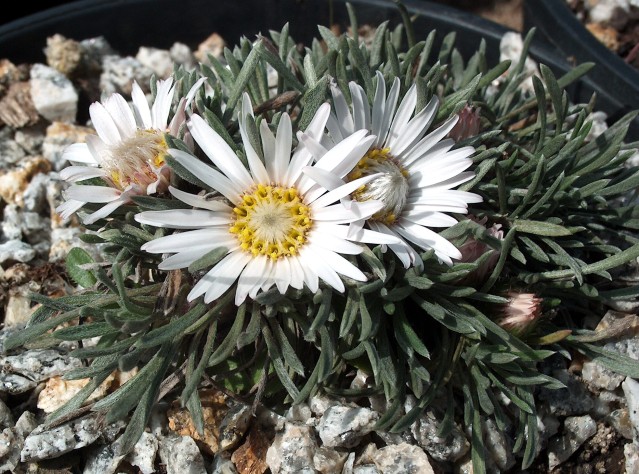
4/9/2011 Jim E. found the beautiful early-bloomer Easter Daisy, Townsendia hookeri on his hike today along the North Rim Road (aka Gate 13). He keyed it out using his microscope and wrote that this species can be distinguished from and similar species, T. exscapa, by the: “tuft of tangled cilia” at the tips of the phyllaries (bracts) below the head of flowers. He also sent this description from Weber & Wittmann “Blooming in early spring in open, rocky sagebrush. Widespread on the plains and outwash mesas of the Front Range.” Thanks, Jim, for sending the beautiful photo.
4/2/2011 Email from Jim E.: “What a memorable high-country hike early afternoon, on this balmy but windy day on the US Forest Service’s Elkhorn Creek Trail at ~8,000 ft. Its trailhead was renovated last year (I’d not even known it was there down the Log Cabin Road, which I’ve been on so many times). To my amazement I spotted the first flowers of the season! I could not believe it; had to go back to the truck for my digital camera.
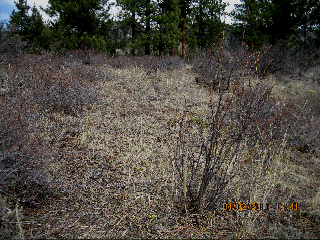
Site where flowers found on Elkhorn Creek Trail
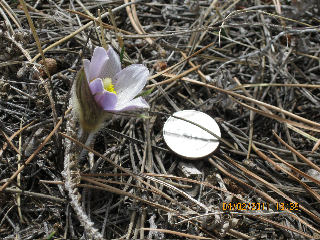
Pasqueflower, Pulsatilla ludoviciana (related to the garden vine, clematis), one of the first early spring flowers of open forests, blooming around Easter
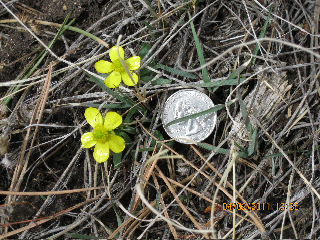
Buttercup, Ranunculus sp., with its yellow, characteristically glossy petals (quarter for scale)
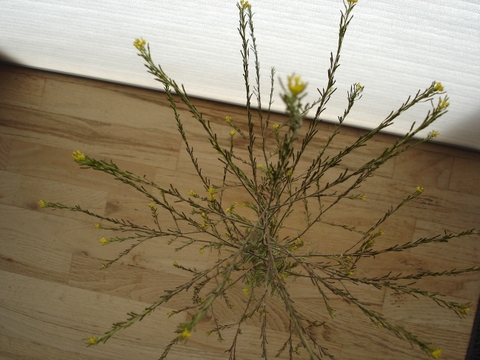
7/26/2010 Email from Linda B: “Hello all, I was weeding in the greenbelt between Mt. Harvard and LaPlatta this morning (filing 8) and came across this plant. This is a new one for me. I couldn’t find a positive ID in my copy of Weeds of the West or in the various materials from the weed district or the state.
It is hairy on the stem, has leaves almost like a potentila, the flower on close inspection is more like a pea than a mustard. If anything, on first glance, to looked to me like a close relative of flixweed (a mustard) but the flowers occur on the tip end of the branches. I counted +/- 5 on one bracket, but they are teeny-tiny. The stem is round and the seed pods look like miniature pea pods….
I will keep this one around in some water for a while if anyone wants to inspect it further. Stop by. I’ll keep it on under my large covered front deck …. My yard of wildflowers is at peak just now too if anyone wants to drive past.”
7/26/2010 Email from Linda B with Renee P’s identification: “Hi all, Renee keyed this out; it is a variety of Descurainia (like flixweed) after all. Here is what she wrote… Interesting isn’t it? Cheers. Linda”
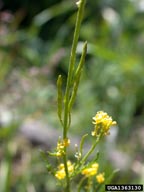
7/29/2010 Notes from Ellen: Here is another link with lots of images from “Forestry Images” website (Forestry Images is a joint project of the Center for Invasive Species and Ecosystem Health, USDA Forest Service and International Society of Arboriculture. The University of Georgia – Warnell School of Forestry and Natural Resources and College of Agricultural and Environmental Sciences) http://www.forestryimages.org/browse/subthumb.cfm?sub=12525.
I’ve inserted one here showing flowers and fruits. Descuraina incana is not on our GVM plant list so I will add it. Thanks Renee and Linda!! Has anyone else come across this one?
7/20/2010 Jeff G. sent these beautiful photos from his trip along the trail this morning! Thanks for taking good care of the trail and sending us an update!
Jim E sent two photos he took of this plant to Jennifer Ackerfield of the CSU Herbarium.
6/24/2010 Jennifer emailed: “Ah, you have Asperugo procumbens. I had it in my yard too this year. Weird little Boraginaceae with downward pointing bristles/hairs on the stem.”
6/24/2010 Jim’s response: “I thought it had to be a borage, what with the coarse ‘hairs’ —Weber & Wittmann say ‘The name borage comes from a Middle Latin source, burra, meaning rough hair or short wool, just as the modern work, bur.’ Somehow, I got trapped in the doublet that led to Symphytum and Anchusa. I should have looked a bit further to Asperugo. The description fits perfectly: ‘Flowers in the axils of the stem leaves; fruiting calyx much larger than the flowers; weakly-stemmed annual with retrorsely prickly hispid leaves. Asperugo Madwort.'”




 Glacier View Meadows Ecology