All posts by GVMEcology Admin

Pine Cone Exhibit at CSU

Renee at Project Pine Cone Exhibit

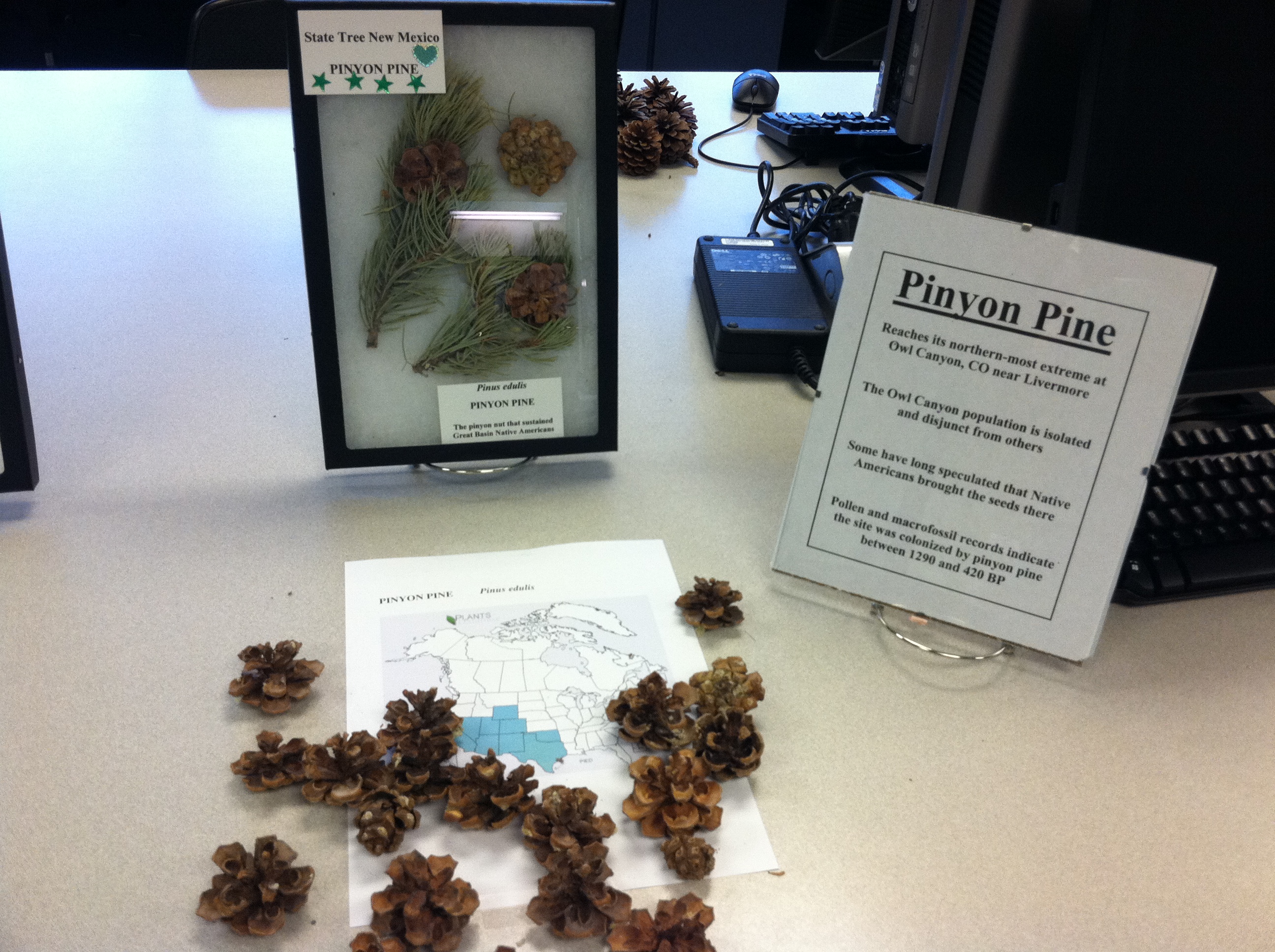
7/24/2011 Last Tuesday I was treated to a tour of Renee Popp’s new pine cone exhibit. It is currently located on the CSU Campus, Yates Hall Lab Room 209  (directions). It took me a little time to find, but there were signs posted on the main door and in the building, so I knew I was on the right track. When I arrived there was a sign saying Renee was working in the CSU Herbarium with a number to call.  She appeared in  just a couple of minutes and welcomed me to her extensive exhibit. She has collected cones and needles from over half of the world’s pine species, displayed in interesting categories and with distribution maps.  There are several examples from GVM, including an interesting witches’ broom in the diseases section. This is an amazing work in progress and to get more specimens, Renee will continue visiting arboreta and universities. She has also set up a Facebook Page so that other pine-lovers can donate cones and share information. If you want a nice escape from the heat, stop by Project Pine Cone on Tuesdays and Thursdays between 10 am and 2 pm. During the summer you can park free at any of the Z parking lots at CSU.
Pheromone Pouch on Old Ponderosa

Pouch Ponderosa
Pouch placed on this Ponderosa

7/7/2011 Email from Wynne: “I put pheromones on a 500 yr. old tree (one we looked at with Jim Erdman on walk ? 2 yrs. ago, who determined the age)—trunk curls around a big rock. ”    Thanks Wynne!

More information from Jim E. about the old Ponderosa in the Haystack USFS Property:

“I looked at the core, one of two I’d taken from opposite sides of that tree 1/20/’09; both hit punk ~5 inches in.  I labeled it ‘2nd Meadow Ponderosa.’  Laurie Huckaby did her usual keen followup dating from mine and got an inside ring date of 1737 into the heartwood – a mere 271 years on a tree with a 2 foot DBH (diameter breast height).  The rings that spanned 1800-1900 were ~1 inch long on the core. So it could well be ~500 years old, among the oldest cohort ponderosas in this area – the 1500s, a favorable century for reproduction.  During the last decade, the years 2002 & 2006 appear as micro-rings for that period, especially very little dark latewood.
Jim
* Every time I look at my cores that Laurie dated over the past couple years, I’m amazed at how her penciled writings and other notations can be so tiny!  You’ve got to see the cores for yourselves. “

Project Pine Cone Exhibit

6/17/2011 From the Coloradoan: “Project Pine Cone is a display of pine cones from around the world in a celebration of our “lowly” or “everyday” pine. It is a hands-on, educational exhibit assembled by local professional botanist, Renee Galeano-Popp. The goal is to share the beauty and diversity of pines while stimulating interest in botany, forestry and ecology. Colorado State University Herbarium is hosting PPC this summer in hopes that local school teachers will incorporate PPC as a learning tool into their science curricula.”

June 16 Garden Work Day

Harry C. checked the Demonstration Garden before our 6:30pm Ecology Meeting 6/8/2011

6/10/2011 From Susan: “The spring work day for the demonstration garden is set for Thursday, June 16, at 8:00 AM. For new comers, the garden is located across the road from the GVM office. We welcome any and all who would like to stop by the garden to check it out or join us in pulling a few weeds, pruning bushes, planting new vegetation, etc.  It’s a great way to get your hands dirty and meet some new folk! Don’t forget sunscreen, hats, and water bottle.”

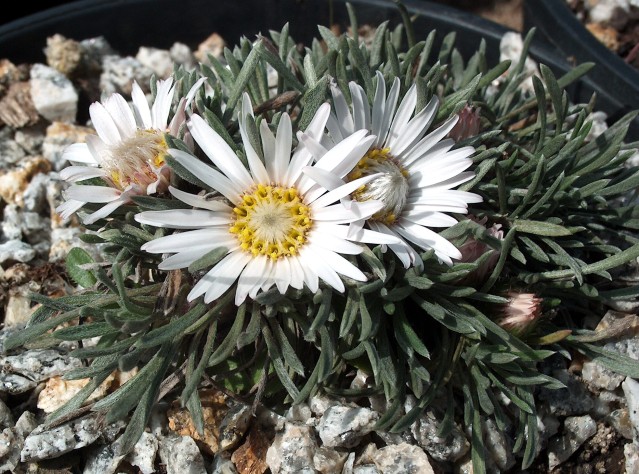
Easter Daisy near Gate 13

Easter Daisy, Townsendia hookeri

4/9/2011 Jim E. found the beautiful early-bloomer Easter Daisy, Townsendia hookeri on his hike today along the North Rim Road (aka Gate 13). He keyed it out using his microscope and wrote that this species can be distinguished from and similar species, T. exscapa, by the:  “tuft of tangled cilia” at the tips of the phyllaries (bracts) below the head of flowers.  He also sent this description from  Weber & Wittmann “Blooming in early spring in open, rocky sagebrush. Widespread on the plains and outwash mesas of the Front Range.”  Thanks, Jim, for sending the beautiful photo.