New strategy for attacking Canada thistle in Crellin Meadow

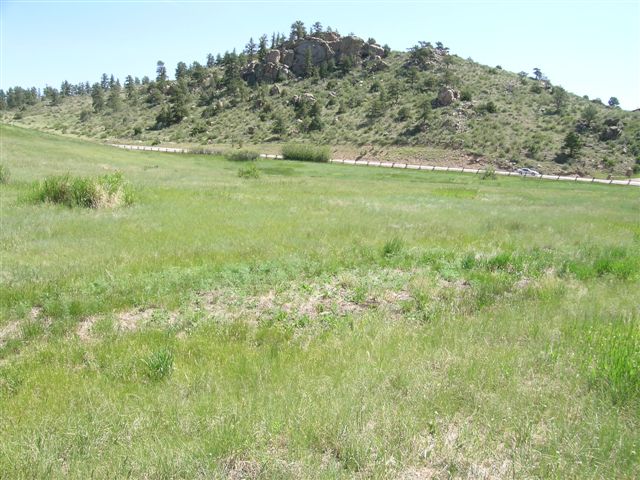
Renee Popp at Crellin Meadow 8/19/09 Note lack of Canada Thistle flowers
Renee Popp at Crellin Meadow 8/19/09. Note lack of Canada Thistle flowers (click image to enlarge).

I asked GVM resident Renee Popp, what her thoughts were on controlling the noxious weed, Canada thistle (CT). As field botanist of over 30 years, both with the USDA Forest Service and as an independent contractor, Renee is an ardent supporter of noxious weed management as a way of improving habitat for our rich store of native plants. This season Renee had a break in her field schedule that allowed her to implement a plan she has been wanting to try for 10 years. On 9/1/09 she wrote:

“Many times I’ve seen the County and now GVM come spray Crellin Meadow (NW of Crellin Lake) where I live, sometimes twice per year. And every time the CT sprouts right back like nothing happened. I think that’s because the treatment is too little too late.

CT operates from an extensive underground root system. To get CT on the defensive, the roots’ reserves need to be compromised if not wholly exhausted. A 4-wheeler with a boom to apply herbicide works great on flat farmlands. However, in the case of Crellin there are trees and wetlands that prohibit a 4-wheeler from making clean sweeps with complete coverage. These obstacles result in pockets of the infestation left untreated. Any plant that is green and photosynthesizing is sending nourishment to the roots.

This year I checked out a spray canister filled with Milestone provided by the GVM office. I spot-sprayed everything that GVM’s 4-wheeler didn’t get. And when a single sprout came up, I sprayed again and again and again. I’ve been re-spraying every week to snuff out new sprouts. It’s been held down long enough now that I expect to see some difference next year.

I realize that the CT population in Crellin Meadow is most likely here to stay, but I still believe we can slow its spread and reduce its size. For this reason I emphasize finding and spraying plants at the outer boundaries as a first priority on this or any other CT infestation.

In the end I guess the message for CT is that intensity may be more important than extensivity. Strategic, complete, high frequency, and targeted hand-spraying may be the keys to reducing and even eliminating weeds vs. just living with weeds and herbiciding broadly forever.”

Batterson Greenbelt Survey June 21 2008

Info added 9/1/09 Because of the Houndstonque at Gate 10 discussion…more info will be forthcoming.

Who: Linda Bell, Chana Fuller and Ellen Heath spent 7 person-hours working at the Batterson Greenbelt, where Charlie Bell and Butters Fuller accompanied us.
Weather: Sunny, low 70s
Description: At the Batterson Greenbelt, we mapped (with a Garmin nuvi 650) and weeded nine sites, see Google Earth map below. Linda helped us identify penny cress (PC), tumble mustard (TM), flixweed (FW), kochia (KO), and hound’s tongue (HT) which were there along with the usual suspects: Canada thistle (CT), Musk thistle (MT) and Dalmatian toadflax (DT). This area was very diverse and a nice contrast to Crellin Lake in terms of overall species diversity.

Map Notes:
Site 1–In a 50 ft diameter area, we clipped and bagged PC that had gone to seed, pulled or hand weed whacked KO, FW, and TM
Sites 2,3,4,6 — These were four test areas Linda Bell had flagged (last year?) to study the effects of stripping the leaves off of DT to weaken them. The numbers on the map indicate the number of plants in each 20 foot diameter area. Linda and Chana stripped the leaves in a downward motion.
Site 5 — This 50 ft diameter site had 100s of TM that we weed whacked before giving up.
Site 7 — We identified a 100 ft diameter area of disturbed soil as a weed hotspot that should be sprayed. The site had it all: CT, MT, HT, PC, F AND it is above Judd and Linda’s property. See photo.
Sites 8, 9 — These two sites are riparian areas with CT, MT.

Linda Bell’s Notes:

On June 24, 2008 Linda Bell emailed “Thanks Ellen for your very comprehensive notes and pictures. Just wanted to follow up with my own list of invasive plants from the reference names used in Weeds of the West. Cheers. Linda

Discussed, identified, not managed:
Stinging nettles
Canada thistle
Field bindweed
Smooth scouringrush (equisetum)
Cow parnisp

Identified and managed in very limited way
Dalmatian toadflax
Common mullein
Musk thistle
Flixweed
Houndstongue
Western sticktight
Smallseed falseflax
Tumble mustard (Jim Hill)
Field pennycress
Prickly lettuce (white sap)”

Helpful Herbicide Pracautions from Tim D’Amato

8/12/09 Tim D’Amato’s email response to Wynne who asked him about precautions when using herbicides: “Hi Wynne, The label for each product has recommended PPE’s (Personal Protective Equipment). I personally would go with long pants, long sleeved shirt, sunglasses or some protective eye wear, latex or rubber gloves, and boots. The greatest risk to exposure is when mixing – concentrated material, chance of splash, etc. Rinse water for eyes, face and hands should be readily available when mixing. A mask should be available for those that feel it is important.

Maybe Steve could supply paper masks and latex gloves when giving out herbicide?

– Tim D’Amato