Category Archives: History

GVM Old Forest

We’re paying closer attention these days to some of the treasures we have in our local forest, especially the number of ancient trees.
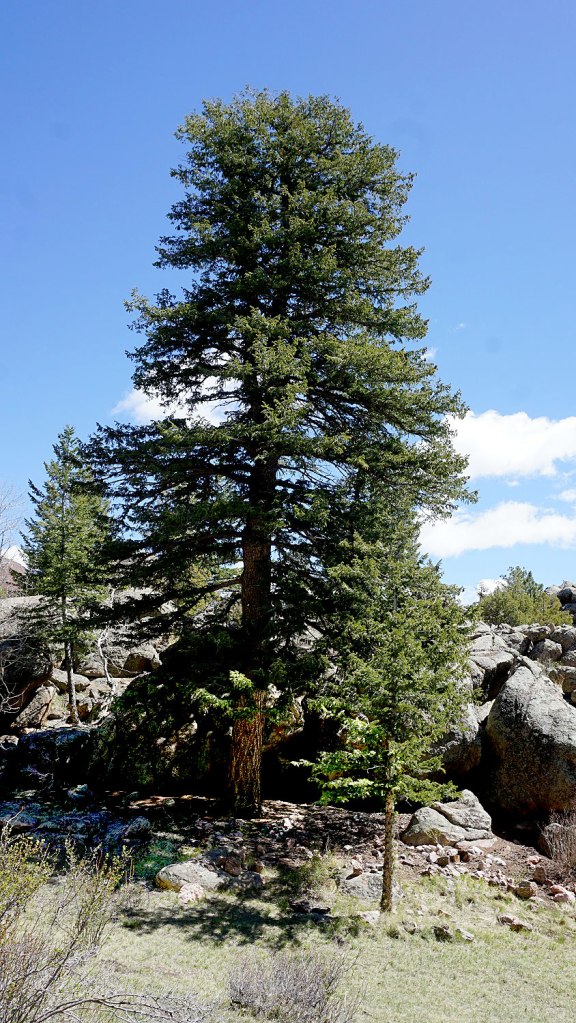
29.5 inch Douglas Fir against a granite outcropping, under a sunny blue sky.

Our work is being hugely assisted by contact we’ve been able to make with Laurie Huckaby, the Forestry Service specialist in Ponderosa pines who assisted our neighborhood those many years ago. She’s now retired, but has sent us invaluable records and has offered to continue supporting our current work.

We live with such an abundance of trees it’s easy to take them for granted–oh, yeah, another tree. Truth is, to know a tree has been growing in our mountain neighborhood for centuries is a reflection of a real miracle.

With the history of Colorado so linked with forestry and mining, the number of legacy trees is actually limited. Entire forested mountaintops, as far as the eye can see, were stripped clear as Colorado was settled, for forestry products, for wood for building, for frameworks supporting mining shafts. And intentional burning of forests was an accepted method for prospecting gold.

Our corner of Northern Colorado escaped much of this historic devastation. But recent events remind us wildfire is always a danger, and changing global climate events pose increasing threats to the forests that surround us.

So we pause in our lives to appreciate these wonders of nature we live with.

Ted Sammond, naturalist and an active member of the Ecology Team at GVM, went out this week to explore and document some trees that appear to have gone unnoticed in the 2009 surveys our residents did.

“The biggest tree I saw today was 36” diameter at breast height.

“The picture of it does not do it justice as it so wide that when I backed up to get the whole tree in the picture it looks small.”

Our studies and building of our records of these trees will continue.

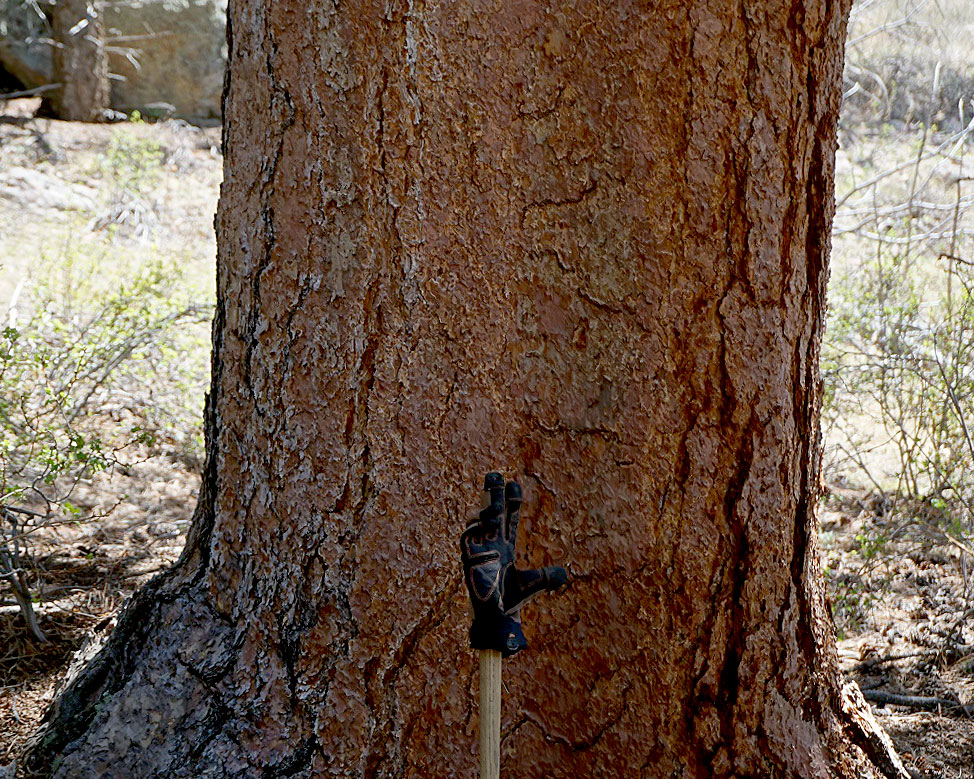
Ponderosa Pine, 36" diameter at breast height, under a sunny blue Colorado sky.
36″ dbh Ponderosa Pine with pole, for scale.

Grandfather Ponderosa

Fifteen years ago the Ecology Team had an active cohort who met regularly and explored our mountain neighborhood with great love and attention.

One of the subjects of their attention was a Ponderosa in the meadow near what we now think of as Iron Mountain Trailhead. In a blog post dated 2009, one of the group chronicles a trip to visit this tree, and plans to have a sample of it cored for age.

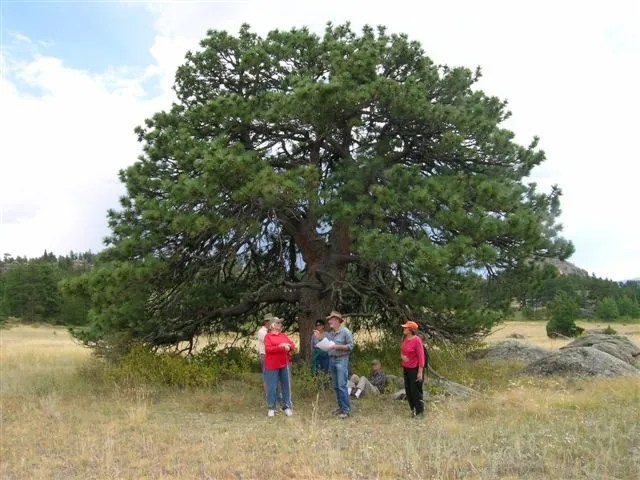
Here are side-by-side images of the tree, the left in 2009, the right this week in 2024.

Subsequent work with the tree established its age at 500 years old–putting its seedling stage at about the time Europeans ventured into the western hemisphere to establish their presence. Christopher Columbus, and so forth.

We’ve heard back now from Peter Brown at Rocky Mountain Tree-Ring Research, who has given us contact information for others involved in this early research. We’ll be following up.

I’m a bit taken back with what appear to be signs of aging over this past 15 years, after five centuries of growth. Even accounting for differences in seasons and artifacts of image-making, there appears to be substantially more dead growth in the branches, leaving noticeable open areas and needle-less areas across the bottom. Coloring is far less vibrant, but that may be a seasonal issue. (The forest areas in the background are deeper greens as well.)

Perhaps we need to be paying attention to this Old Guy. Are there preservation steps we should be taking to protect his future? Are there forestry maintenance issues we could be taking? What are the implications of cleaning out dead branches?

GVM Natural History Report Online

Manhead Mtn Photo
Manhead Mountain in Glacier View Meadows, CO (Photo by Jim Erdman)

In October 2012 Jim Erdman submitted a 26-page report http://mummyrangeinstitute.org/glacier-view-natural-history.pdf  to the Mummy Range Institute which has featured it on their website.  It is a “must read” for those of us who love the ecology, geology and beauty of GVM. Thank you Jim for your lucid writing and beautiful photos! For more information on the important work being done by the Mummy Institute, visit their website http://mummyrangeinstitute.org/.

Log Cabin Rd vs. Boy Scout Rd

4/3/2011 In the previous post, Jim accessed the new Elkhorn Creek Trail from the Log Cabin Rd. I asked him if that was the same as the Boy Scout Rd. He emailed:  “Log Cabin Road and Boy Scout Road (CR 68C), the same, although the latter name appears in Among These Hills: A History of Livermore, Colorado.  The former stems from the Log Cabin Hotel, post office, and stage stop at the T juncture of  CR 68C with the Red Feather Lakes Road (CR 74E).  One can still see the concrete foundation of one of the buildings.” Thanks for the clarification and history lesson, Jim.

Jim sent additional information from that book on p. 26 : “The two-story [hotel] structure was originally built at the Ashley Grange, a place for training young English ‘remittance’ men how to become ranchers.  It had been moved several miles north to this site in 1888 . . ..”   Jim added “Such men appear to have been not a rarity in the Livermore region.”

GVM area fire history updates

Jim Erdman forwarded an email exchange he had with Laurie Huckaby (USFS specialist in the fire history of this region — her passion, tree rings)
On 11/02/2009 Laurie wrote: “The last widespread fire in the Kelly Flats area was actually in the fall of 1871….I pick up the 1871 fire date in Young’s Gulch as well. There was a more localized event in 1880, a date that shows up at Gateway Park, too. The important thing to note about the historical fire regime is that although you could say there was a fire in any given location every 30 to 60 years, many of those fires were very localized, and fire frequency and intensity were not consistent through time. The late 1700s-early 1800s were a cold, wet period with reduced fire frequency; the mid-1800s were warm and dry, with more frequent fire that coincided with the settlement of this area. Direct fire suppression was not all that effective in your area [GVM] until the 1940s and 1950s, but heavy grazing in the late 1800s-early 1900s effectively stopped fire spread during that period. As for the oldest ponderosa pines, there are several living ones that date into the 1300s not too far from you. There is one on the Shambala Mountain Center property (near Red Feather Lakes)  that dates to 1321, and one on the north rim at Pingree Hill that dates to 1336. Go to Peter Brown’s OLDLIST website  to see a list of old trees submitted by tree-ring scientists. I finally got a chance to cut that stump John [Popp] and I collected. It is a Rocky Mountain Juniper! I didn’t expect that. It has no fire scars but lots of rings. Hopefully I’ll get a chance to date it in the next couple of weeks. I’ll let you know when I do.”

11/2/2009 Part of Jim Erdman’s email response: “…Dating that juniper in what you’d called “a pretty interesting place” — the Mount Peale green belt — may help with that charred ponderosa stump nearby. I cored a close-by, very young ponderosa established since the burn, and you dated the pith at only 1930! The site by Iron Mountain Drive lies in a very mesic spot where I’m sure snow accumulates.”