Category Archives: Forest Mgmt

GVM Old Forest

We’re paying closer attention these days to some of the treasures we have in our local forest, especially the number of ancient trees.
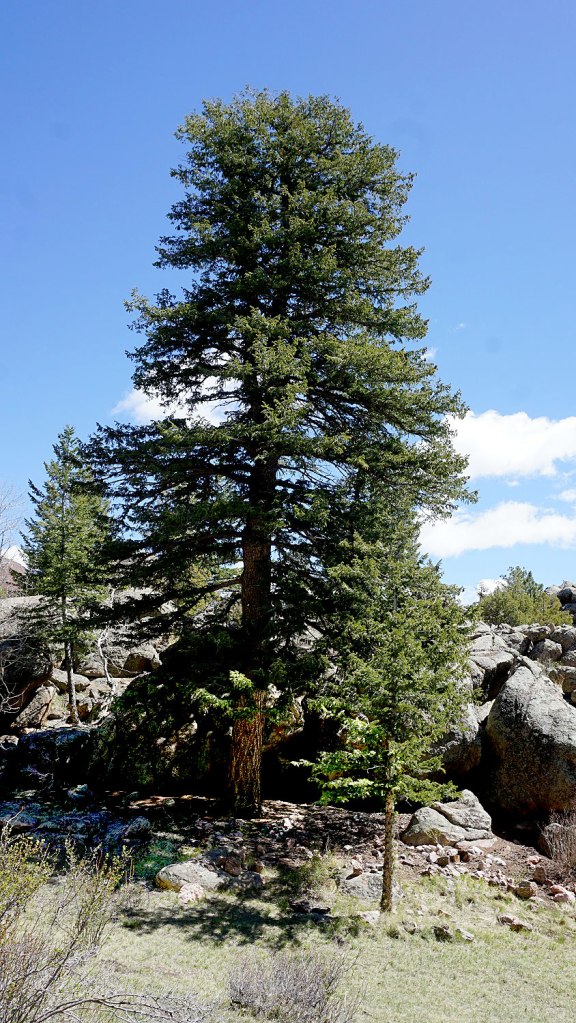
29.5 inch Douglas Fir against a granite outcropping, under a sunny blue sky.

Our work is being hugely assisted by contact we’ve been able to make with Laurie Huckaby, the Forestry Service specialist in Ponderosa pines who assisted our neighborhood those many years ago. She’s now retired, but has sent us invaluable records and has offered to continue supporting our current work.

We live with such an abundance of trees it’s easy to take them for granted–oh, yeah, another tree. Truth is, to know a tree has been growing in our mountain neighborhood for centuries is a reflection of a real miracle.

With the history of Colorado so linked with forestry and mining, the number of legacy trees is actually limited. Entire forested mountaintops, as far as the eye can see, were stripped clear as Colorado was settled, for forestry products, for wood for building, for frameworks supporting mining shafts. And intentional burning of forests was an accepted method for prospecting gold.

Our corner of Northern Colorado escaped much of this historic devastation. But recent events remind us wildfire is always a danger, and changing global climate events pose increasing threats to the forests that surround us.

So we pause in our lives to appreciate these wonders of nature we live with.

Ted Sammond, naturalist and an active member of the Ecology Team at GVM, went out this week to explore and document some trees that appear to have gone unnoticed in the 2009 surveys our residents did.

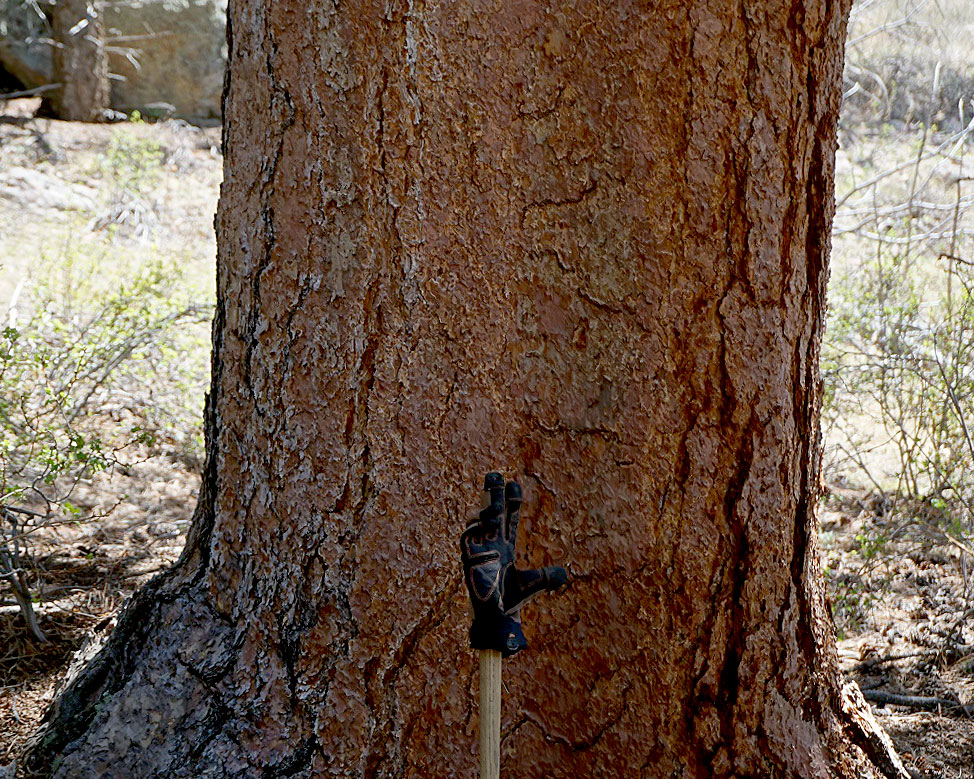
“The biggest tree I saw today was 36” diameter at breast height.

“The picture of it does not do it justice as it so wide that when I backed up to get the whole tree in the picture it looks small.”

Our studies and building of our records of these trees will continue.

Ponderosa Pine, 36" diameter at breast height, under a sunny blue Colorado sky.
36″ dbh Ponderosa Pine with pole, for scale.

Grandfather Ponderosa

Fifteen years ago the Ecology Team had an active cohort who met regularly and explored our mountain neighborhood with great love and attention.

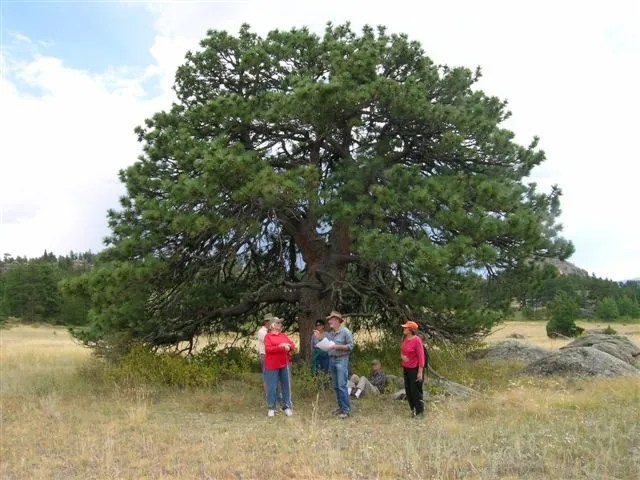
One of the subjects of their attention was a Ponderosa in the meadow near what we now think of as Iron Mountain Trailhead. In a blog post dated 2009, one of the group chronicles a trip to visit this tree, and plans to have a sample of it cored for age.

Here are side-by-side images of the tree, the left in 2009, the right this week in 2024.

Subsequent work with the tree established its age at 500 years old–putting its seedling stage at about the time Europeans ventured into the western hemisphere to establish their presence. Christopher Columbus, and so forth.

We’ve heard back now from Peter Brown at Rocky Mountain Tree-Ring Research, who has given us contact information for others involved in this early research. We’ll be following up.

I’m a bit taken back with what appear to be signs of aging over this past 15 years, after five centuries of growth. Even accounting for differences in seasons and artifacts of image-making, there appears to be substantially more dead growth in the branches, leaving noticeable open areas and needle-less areas across the bottom. Coloring is far less vibrant, but that may be a seasonal issue. (The forest areas in the background are deeper greens as well.)

Perhaps we need to be paying attention to this Old Guy. Are there preservation steps we should be taking to protect his future? Are there forestry maintenance issues we could be taking? What are the implications of cleaning out dead branches?

Mule-deer Nibbled Ponderosa Tips

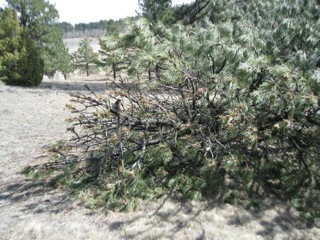
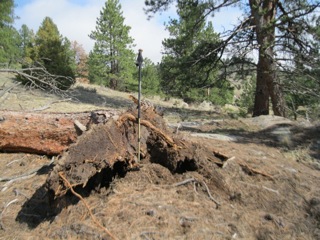
4/12/2012 Jim E sent this information along with photos, thanks Jim!  “Yesterday I happened to be walking along a game trail here in Glacier View Meadows and spotted a fairly newly wind-thrown ponderosa.  As I’d seen easily accessible branch tips nibbled on along Haystack Rd sometime ago, and didn’t know what did it, this seemed to clinch deer as the cause. The roots are extremely shallow as shown here. The trunk leading off to the left. Here’s the top of the tree showing easily reached – by deer – relatively palatable needles and branch tips.” Jim observed about a dozen piles of deer scat around the tree suggesting that deer are the culprits. He has sent an email to Mark from the Division of Wildlife to ask about mule deer forage habits.

“Finally, this closeup showing a couple plants of wild candytuft (Noccaea [formerly Thlaspi] montana) growing through the pile, which must have been laid before the spring-bloom season.  I’ve Olaus Murie’s 1958 classic, A Field Guide to Animal Tracks, that includes photos of droppings.  They show the winter feeding(or dry diet), and the soft type that results from green or succulent food in summer.  Maybe your folks can tell.”

Pine Cone Exhibit at CSU

Renee at Project Pine Cone Exhibit

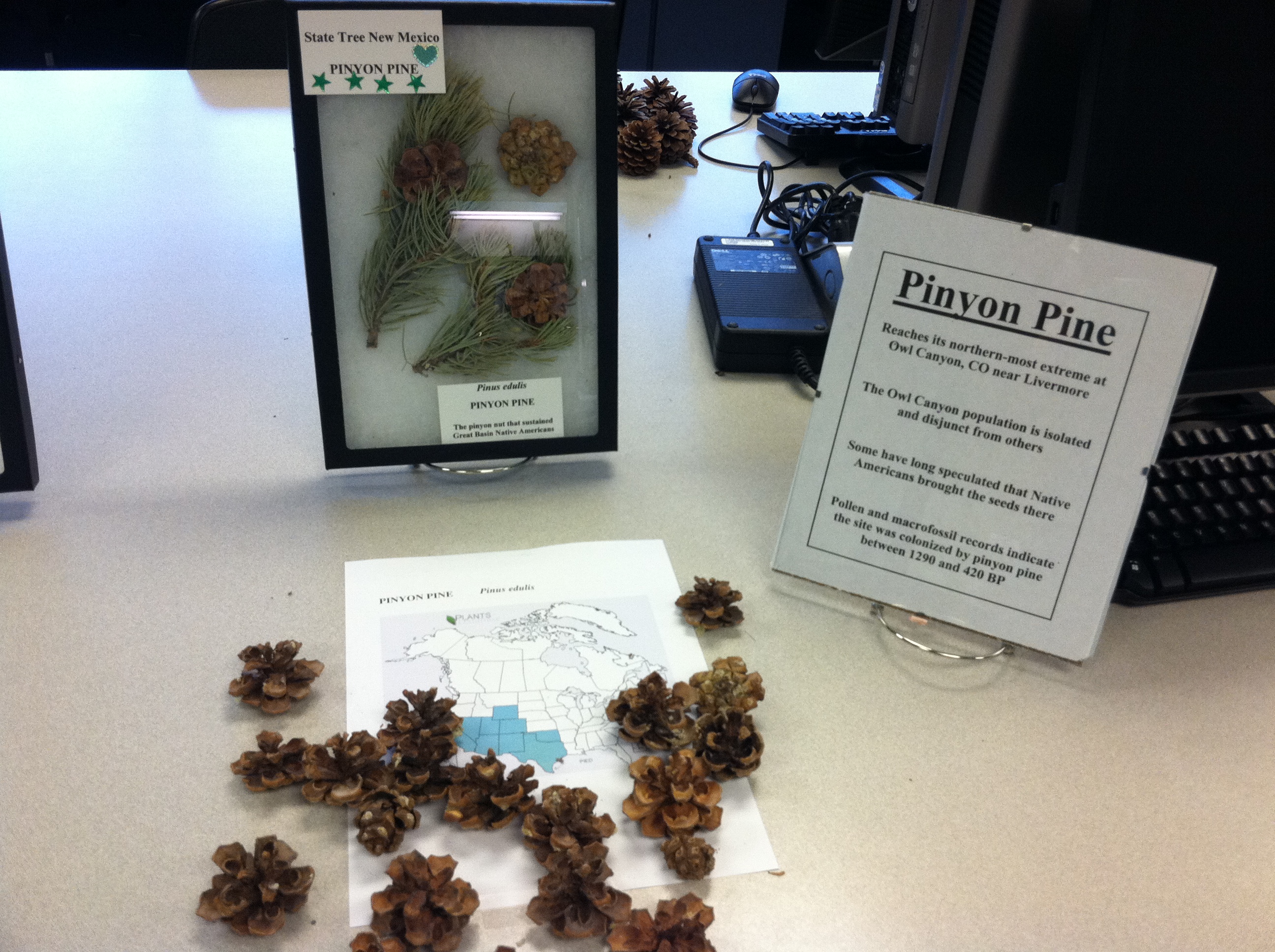
7/24/2011 Last Tuesday I was treated to a tour of Renee Popp’s new pine cone exhibit. It is currently located on the CSU Campus, Yates Hall Lab Room 209  (directions). It took me a little time to find, but there were signs posted on the main door and in the building, so I knew I was on the right track. When I arrived there was a sign saying Renee was working in the CSU Herbarium with a number to call.  She appeared in  just a couple of minutes and welcomed me to her extensive exhibit. She has collected cones and needles from over half of the world’s pine species, displayed in interesting categories and with distribution maps.  There are several examples from GVM, including an interesting witches’ broom in the diseases section. This is an amazing work in progress and to get more specimens, Renee will continue visiting arboreta and universities. She has also set up a Facebook Page so that other pine-lovers can donate cones and share information. If you want a nice escape from the heat, stop by Project Pine Cone on Tuesdays and Thursdays between 10 am and 2 pm. During the summer you can park free at any of the Z parking lots at CSU.

Pheromone Pouch on Old Ponderosa

Pouch Ponderosa
Pouch placed on this Ponderosa

7/7/2011 Email from Wynne: “I put pheromones on a 500 yr. old tree (one we looked at with Jim Erdman on walk ? 2 yrs. ago, who determined the age)—trunk curls around a big rock. ”    Thanks Wynne!

More information from Jim E. about the old Ponderosa in the Haystack USFS Property:

“I looked at the core, one of two I’d taken from opposite sides of that tree 1/20/’09; both hit punk ~5 inches in.  I labeled it ‘2nd Meadow Ponderosa.’  Laurie Huckaby did her usual keen followup dating from mine and got an inside ring date of 1737 into the heartwood – a mere 271 years on a tree with a 2 foot DBH (diameter breast height).  The rings that spanned 1800-1900 were ~1 inch long on the core. So it could well be ~500 years old, among the oldest cohort ponderosas in this area – the 1500s, a favorable century for reproduction.  During the last decade, the years 2002 & 2006 appear as micro-rings for that period, especially very little dark latewood.
Jim
* Every time I look at my cores that Laurie dated over the past couple years, I’m amazed at how her penciled writings and other notations can be so tiny!  You’ve got to see the cores for yourselves. “