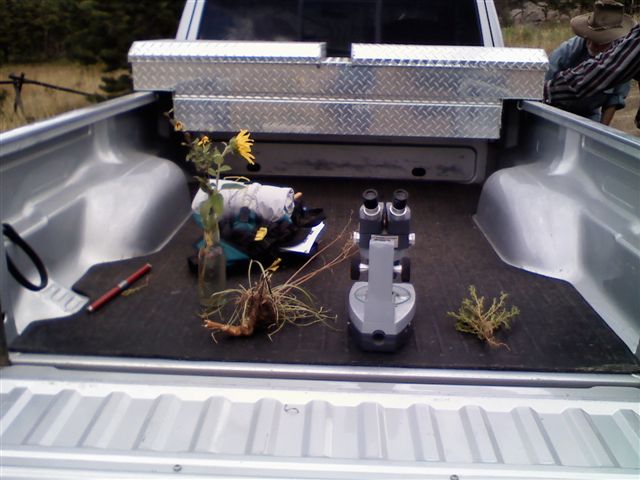
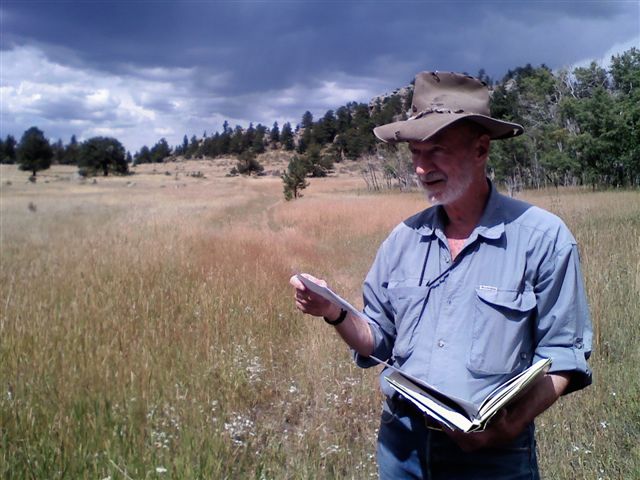
9/7/2009 Jim E. led a nature walk in the Forest Service inholding at Haystack Dr with Andre, Ellen, Judy, Karen D., Mary, Warren & Wynne on a partly sunny September afternoon. We started with an overview by Jim’s truck with a poster that included a table entitled “The World’s Oldest Known Trees,” and displays of annual sunflower, valerian root, and fetid marigold. Jim passed around the valerian root (the plant is called edible valerian or tobacco root) for us to smell and he read about its medicinal uses.
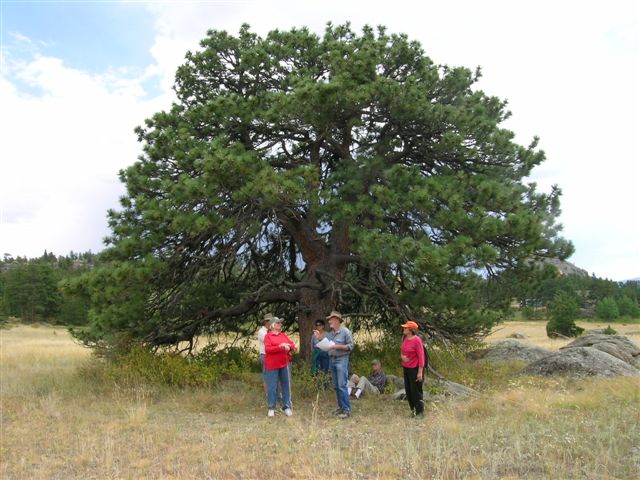
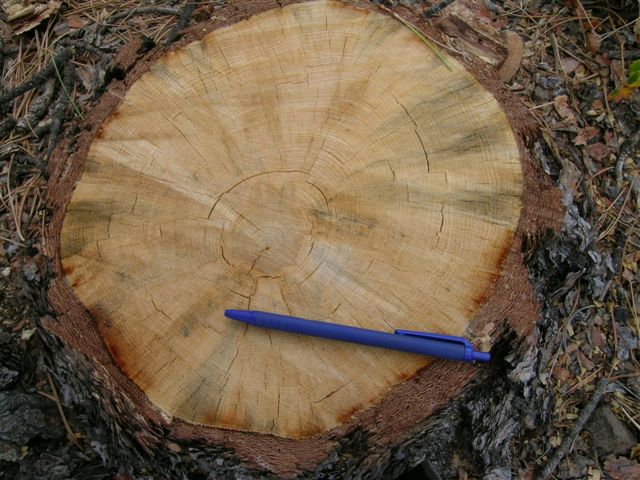
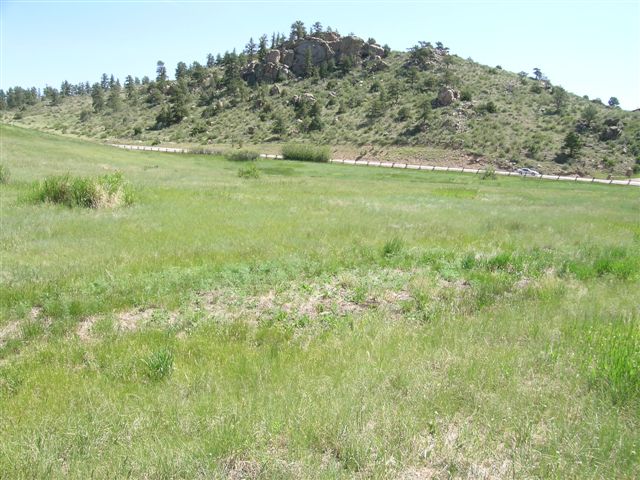
Trees: Jim showed the trees that he identified for Laurie Huckaby and John Popp, of the U.S. Forest Service, as potentially very old trees from the 1500s. He pointed out these old trees may have survived due to protection by surrounding rocks.
10/16/09 Jim emailed additional information: “During the May 20th outing with Laurie Huckaby, the local USFS’s key researcher on the fire history of this northern region, she said the few old meadow trees belonged to that ~1500 A.D. cohort, a period of ample moisture. Indeed, she’d cored a large ponderosa in that cluster, untouched by beetles. The pith date: 1575, with her estimated real age of 1535. Yet she’s found 700-800 year-old ponderosas up in the Red Mountain area to the north. Roughly 200-year intervals occur between cohorts, established during off-year drought cycles. The oldest known ponderosa — 880-890 — was found in Utah. That, based on a table, ‘The World’s Oldest Known Trees’ in a USGS/USFS poster (no date), Colorado’s Ancient Trees.”
Mountain Pine beetle: We saw several pine beetle-infested trees that had been cut down within a cluster of infested trees. The wood was then stacked and wrapped in plastic by the U.S. Forest service.
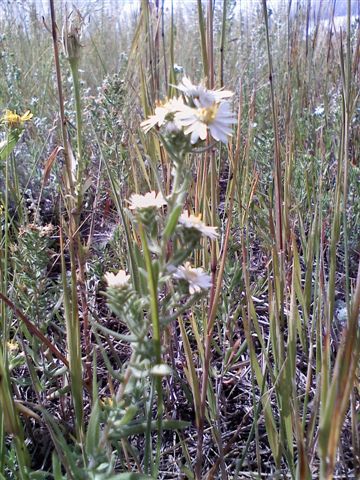
Flowers: yarrow, blanket flower, gumweed, black-eyed susan, smooth white aster or Porter aster, valerian, yellow owl-clover, yellow sweet-clover, bottle gentian, tansy aster, golden aster,
Info added 9/1/09 Because of the Houndstonque at Gate 10 discussion…more info will be forthcoming.
Who: Linda Bell, Chana Fuller and Ellen Heath spent 7 person-hours working at the Batterson Greenbelt, where Charlie Bell and Butters Fuller accompanied us. Weather: Sunny, low 70s Description: At the Batterson Greenbelt, we mapped (with a Garmin nuvi 650) and weeded nine sites, see Google Earth map below. Linda helped us identify penny cress (PC), tumble mustard (TM), flixweed (FW), kochia (KO), and hound’s tongue (HT) which were there along with the usual suspects: Canada thistle (CT), Musk thistle (MT) and Dalmatian toadflax (DT). This area was very diverse and a nice contrast to Crellin Lake in terms of overall species diversity.
Map of Batterson Greenbelt Survey June 21 2008
Site 7 Weed Hot Spot in Batterson Greenbelt
Map Notes: Site 1–In a 50 ft diameter area, we clipped and bagged PC that had gone to seed, pulled or hand weed whacked KO, FW, and TM Sites 2,3,4,6 — These were four test areas Linda Bell had flagged (last year?) to study the effects of stripping the leaves off of DT to weaken them. The numbers on the map indicate the number of plants in each 20 foot diameter area. Linda and Chana stripped the leaves in a downward motion. Site 5 — This 50 ft diameter site had 100s of TM that we weed whacked before giving up. Site 7 — We identified a 100 ft diameter area of disturbed soil as a weed hotspot that should be sprayed. The site had it all: CT, MT, HT, PC, F AND it is above Judd and Linda’s property. See photo. Sites 8, 9 — These two sites are riparian areas with CT, MT.
Linda Bell’s Notes:
On June 24, 2008 Linda Bell emailed “Thanks Ellen for your very comprehensive notes and pictures. Just wanted to follow up with my own list of invasive plants from the reference names used in Weeds of the West. Cheers. Linda
Discussed, identified, not managed:
Stinging nettles
Canada thistle
Field bindweed
Smooth scouringrush (equisetum)
Cow parnisp
Identified and managed in very limited way
Dalmatian toadflax
Common mullein
Musk thistle
Flixweed
Houndstongue
Western sticktight
Smallseed falseflax
Tumble mustard (Jim Hill)
Field pennycress
Prickly lettuce (white sap)”
6/27/09 : “Here are a few more pics from the Utah DER, maybe you could post a few on the blog you created? I also made a comment on our work there and my next project at Camp Gurnsey. Thanks for posting this stuff up!” Read the details from Paul’s email by clicking the link below his photos….
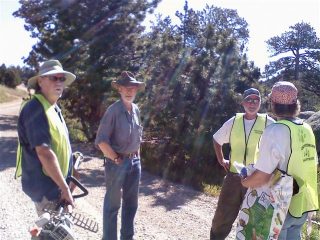
June 28, 2009: Our June work day was a multipurpose one: Peggy weeded and identified problem spots on the Nature Trail, Jeff and Judd brought weed-eaters to clear the West Crellin trail, Judd diverted water from a slippery spot on the #4 marker on the Nature Trail, Jim and Ellen started a photo catalog of plants on the Nature Trail and removed a few Canada and musk thistles too. Person-hours worked: 7.5 Weeding and Trails Maintenance, 5 Plant Photo Catalog.












 Glacier View Meadows Ecology