Read an email exchange between Jim and Paul describing their work on tree ring dating big ponderosas and what this predicts about historical fires in the our area. Who can recommend good natural history references for our winter reading?
Continue reading Fire ecology, ponderosa tree rings….counting…..counting
Welcome to our EcoBlog
Hi Everyone,
Thanks for letting me spend some more time on this blog! I sure appreciated your helpful and insightful thoughts during last month’s meeting and hope we can build a simple, interactive e-bulletin board, a centralized location for our calendar, documents, emails, pictures, videos, and useful links. It might also be fun to post updates during the “off-season.” I hope you’ll have a chance to leave a comment before next Wednesday, even just a thumbs up or thumbs down!
Ellen
request information by filling out form below


Oct 22=Demo Garden Work Day
As we head toward winter, Susan will be spearheading the fall garden maintenance duties. Read her comment (below) with all the details!
Corwins guide tour of Crellin Canyon Nature Trail
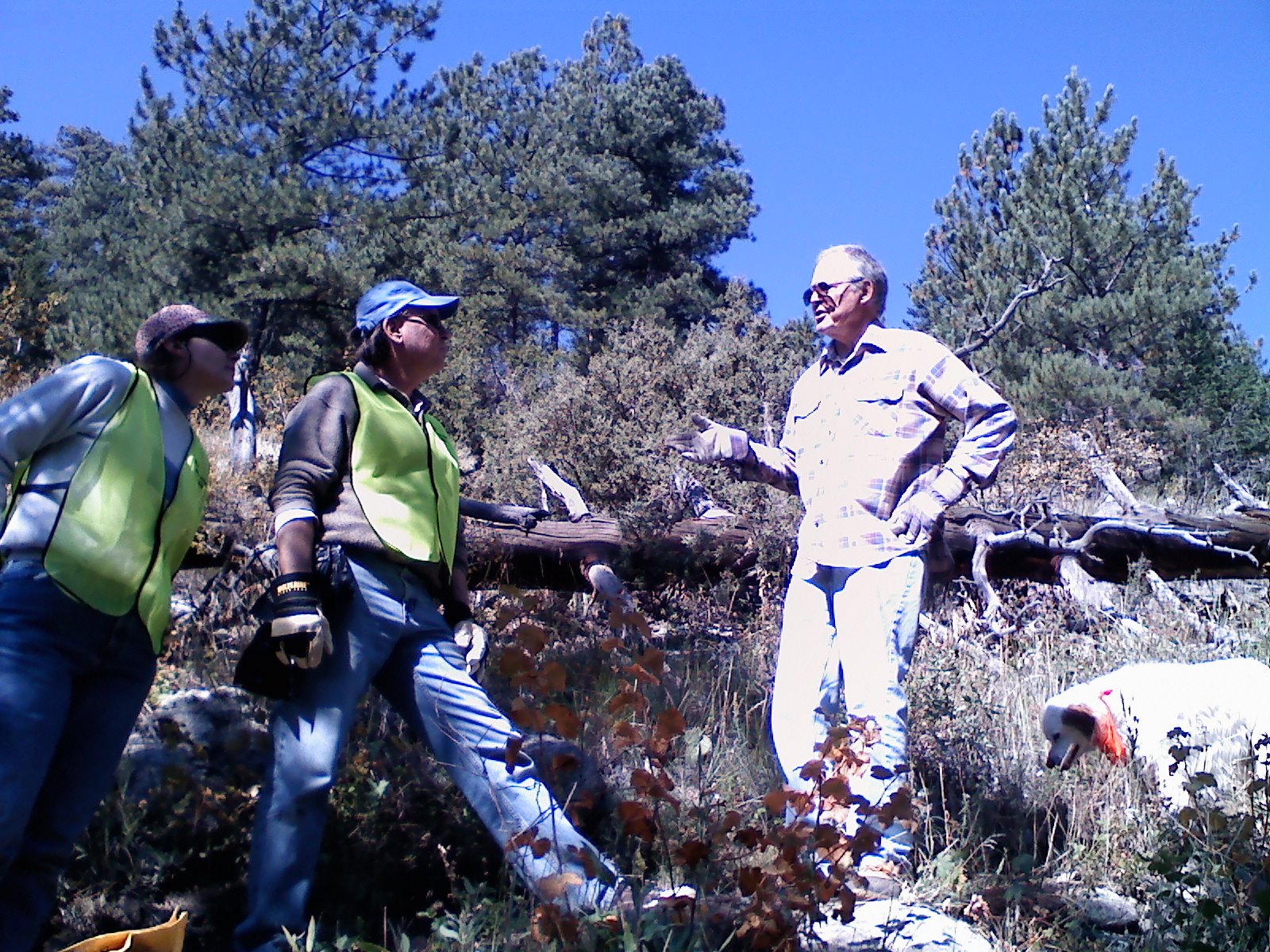
9/20/08 9-11:30am: For our September Ecology work day, Harry and Judy Corwin led Jeff, Peggy and me down the trail, pointing out the 27 trail markers and 4 information brochure boxes. During the outing, information boxes were replenished, a rotten trail post was replaced, overhanging branches were clipped, poisin ivy was removed and flagged (at the request of Linda Bell), and a few mullein heads were clipped and bagged.
I took pictures and gps readings along the way and estimate that the trail is 0.75 miles roundtrip with a 300 foot drop into the canyon. Thank you Corwins for all the work you have put into the trail during the last 10+ years.

Eureka! Mountain Sagebrush Sighting
Read about Jim’s confirmation of Linda Bell’s observation of Mountain Sagebrush near Azubah’s grave in the Batterson Greenbelt.
On Sep 12, 2008, at 9:13 AM, LINDA BELL wrote:
Hi again,
I also question mountain big sagebrush that is an aspect dominant up near Red Feather Lakes. Definitely woody, it’s easily identified by using a black light on leaves mashed in water; the solution fluoresces a milky blue.
Interesting about the sagebrush — I was very surprised last year to find two isolated sagebushes up on the slope above the Batterson greenbelt. Not sure I could find them again, I was off cross-country going up some game trail, but I could give it a try and bring a specimen twig/branch. It’s the only sagebrush I’ve seen around GVM, but then, we all have our own extended territories, so that’s not to say there are not other isolated plants. It thought at the time though that I’d never seen the plant this low in elevation. Around here the common lore is that once you come across mountain sagebrush, you won’t find rattlesnakes.
Linda Bell
On Oct 2, 2008 Jim Erdman emailed Linda Bell:
Linda,
As I was helping pick up roadside trash this a.m.—my charge from Gate 3 through 5—I noted a small gravestone in the trees above the grassy Batterson greenbelt at Gate 5. As a gate access was along the main road, curious, I went up to the site of Azubah Ella, the 10-year-old daughter of “S. & Mary L. Batterson” who died in December 1878. (What a strange name, Azubah.) I noted an orange lichen, likely Xanthoria elegans, on the limestone headstone. Then when I looked up the slope I saw amongst the mountain mahogany a single plant of mountain sagebrush. I brought a specimen home, mashed the leaves in water, zapped it with my black light, and voila! the fluid fluoresced the diagnostic milky blue that separates it from basin and Wyoming sagebrush. Serendipity. Have to admit that I was very surprised to see it down here; it’s the dominant shrub in the clearings up at Red Feather Lakes, fully a thousand feet higher. You, too, found its occurrence down here in GVM surprising.
Jim
*Another shrub added to the list….your mountain sagebrush (Weber’s Seriphidium [Artemisia] vaseyanum)
Ellen added this from Jim’s 10/4 email: It used to be called by some Mountain Big Sagebrush, as opposed to Basin Big Sagebrush or Wyoming Big Sagebrush when the three were subspecies of Artemisia tridentata (A. t. subsp. vaseyana, A. t. subsp. tridentata, and A. t., subsp. wyomingensis, respectively). We’ve both mountain and big sagebrush here along the Front Range, the latter infrequent. I might grab another specimen of Mountain Sagebrush at the gravesite to show those who might be interested at the meeting how it fluoresces under UV.
 Glacier View Meadows Ecology